Truth is a Pathless Land - The Teachings of Jiddu Krishnamurti
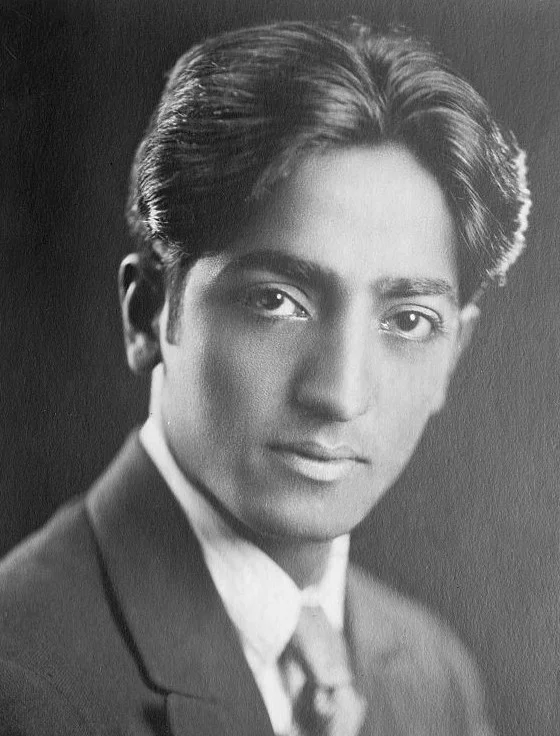
Krishnamurti. If you’re read any of his books, you’ll know it’s hard to call him anything. He’s not really a philosopher or teacher… and certainly he would strongly reject the claim to be a guru.
I’d like to share what I’ve learnt from my visits to The Krishnamurti Centre in Hampshire, UK, over the last twenty years or so. It’s a centre he helped to create, a space designed to reflect on his teachings in a natural environment, free from any coercion, timetable or pressure.
I first came across K when I was around 21 years old. I read the book Freedom from the Known (Amazon link), and I was hooked. In fact, I went to observe the school that Krishnamurti developed called Brockwood Park School, and almost ended up becoming a teacher there.
After studying K for about a year or so, I found myself a little stuck. I spent far more time watching his videos and reading his books, than actually spending time in silence or going for walks. So I decided to let the theory go and ended up following my own path.
What I Learnt at the Krishnamurti Centre
I came back to him years later, by a roundabout route. I was teaching at St James School in London, where every child meditated as an ordinary part of the school day. When I left to become a full-time mindfulness teacher, I started going back to the Centre in Hampshire a few times a year, and I’ve been returning ever since.
What changed on those later visits was that I stopped studying him.
In my twenties I read a shelf of his books before I got anywhere near the essence of what he was actually saying. The irony caught up with me eventually. He spent his life insisting that truth is a pathless land, and I had quietly turned his teachings into a path. Another system, with reading on it.
So on the later visits I simply went. I sat in the silence of the place. I talked with the people who were there, real conversations about how to live consciously and with some wisdom, which is not a conversation most of us get to have very often. The Centre is surrounded by nature, so as much of it happens on a walk outside as in any room.
And here’s what I actually took away: the power of not knowing.
Not knowing sounds like a lack. In practice it’s the opposite. It means holding what you think as a question rather than announcing it as settled truth. It means genuinely listening to someone whose view differs from yours, rather than waiting for your turn to speak. It means noticing a thought, a feeling, a sensation arising in awareness, without having to follow that train all the way to its conclusion.
I’ve stopped thinking of any of this as leading somewhere. There’s no final point called awakening, or self-realisation, or enlightenment, or whichever word you prefer. There’s an ongoing living presence, and there’s the journey, and the journey is the thing.
Which brings me to a word I’ve come to love. Curiosity comes from the Latin curiosus, meaning “careful, diligent, inquiring eagerly”, which is akin to cura: care. Curiosity and care share a root. To be curious about something is a way of caring about it. To be curious about this moment, about yourself, about the person in front of you, is a form of care for them.
That’s what I learnt at the Krishnamurti Centre. It took me about twenty years and a great deal of unnecessary reading to get there.
Krishnamurti has a fascinating biography. Born in a very poor family, he was spotted on a beach and identified as having a very pure ‘aura’ that showed not even a hint of selfishness.
He was then trained to be a world teacher by the Theosophical Society, a ‘star from the east’. But after a few years, he rejected that role and spent the rest of his life on his mission to ‘set human beings completely and unconditionally free’.
What “Truth Is a Pathless Land” Actually Means
I won’t attempt to summarise K’s teachings, partly because summarising him is a version of the mistake I made in my twenties. But the phrase itself comes from a statement he wrote in 1980, at the request of his biographer Mary Lutyens. It opens:
Truth is a pathless land. Man cannot come to it through any organization, through any creed, through any dogma, priest or ritual, not through any philosophical knowledge or psychological technique.
That is the whole argument in two sentences. No organisation gets you there. No method, however sophisticated, and that includes his own. He goes on to say you find it instead through the mirror of relationship and through understanding the contents of your own mind, by observation rather than by analysis.
Which is exactly where I got stuck, and exactly what those later visits taught me. You cannot study your way in.
The full statement runs to several hundred words and is worth reading slowly. The Krishnamurti Foundation publishes it in full: The Core of the Teachings.
Have you studied J. Krishnamurti? What are your experiences with his teachings? Let me know, if you have a few moments and want to share. Thank you!
Related Blogs I’ve written that you may enjoy:
Some links in this post go to Amazon. If you buy through one, I may earn a small commission at no extra cost to you. I only ever link to books and things I've actually read or use.