Dalai Lama: Smiling more important than meditating
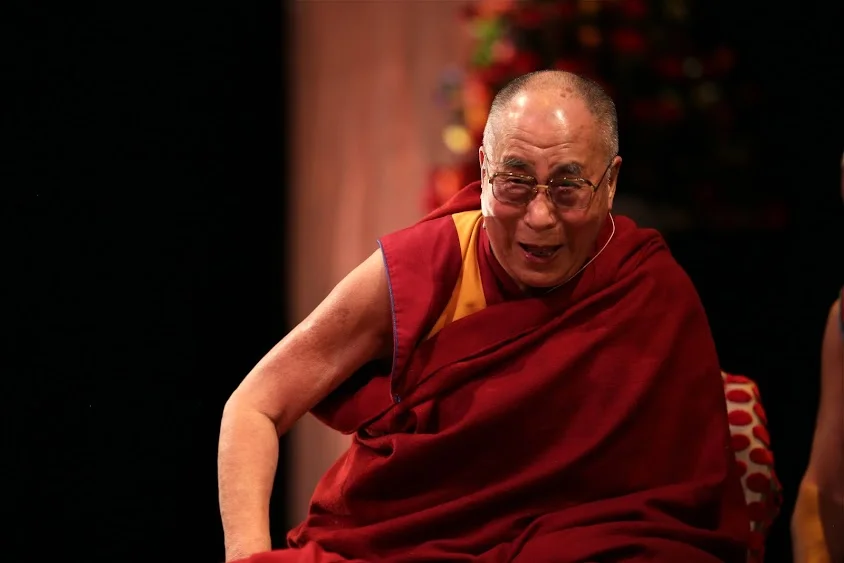
The short version: the Dalai Lama says his own practice, when he meets anyone at all, is simply to smile. He calls it “wise selfish behaviour”, because it lifts him as much as the person in front of him. He has also said it can be more valuable than meditating.
Back in 2015 the Dalai Lama spoke at the Lyceum Theatre in London, at an event hosted by Action for Happiness. I was lucky enough to be there, and to volunteer to help organise it.
Of everything he said that day, the thing that stayed with me was what he said about smiling.
“My practice when I see someone, is to smile”
That’s his actual practice. Not a nice idea he recommends to other people. A practice, done deliberately, as an act of kindness, to lift the spirits of whoever is in front of him.
And he knows perfectly well that it makes him feel good too. That’s what he calls wise selfish behaviour. You do the kind thing, and the kindness comes back around to you. No wonder that man is so popular. He must have smiled a million times.
The line that surprised the room was that smiling can sometimes be more valuable than meditating. Quite something from a man who wakes at 3am to meditate for several hours.
Someone on my mindfulness teacher training once told me she had met him as a teenager, in a small group. She said his smile was so contagious it lifted the whole group, every single time, without a word being spoken.
He is not above a joke, either
Here he is telling a story about a bird. It’s short, it’s silly, and it shows the human being rather than the icon. See if you can get through it without cracking a smile.
The science of smiling, ten years on
When I first wrote this post I promised I’d come back to the science of smiling, and the old “act as if” principle: the idea that putting on the expression can nudge the feeling, rather than only the other way round.
I’m glad I waited, because the evidence has changed since 2015.
For years this was psychology’s most famous wobble. The classic pen-in-the-teeth studies, which forced people into something like a smile, failed to replicate, and a lot of researchers quietly wrote the whole thing off.
Then a large group of psychologists who genuinely disagreed with each other joined forces to settle it properly. The Many Smiles Collaboration ran a preregistered study across 3,878 people in 19 countries. When participants deliberately posed a smile, or mimicked a smiling face, it both amplified and initiated feelings of happiness (Coles et al., Nature Human Behaviour, 2022).
The honest caveat, which the researchers state themselves: the sneaky pen-in-mouth version still gave murky results. So this isn’t “hold a pencil in your teeth and cheer up”. It’s narrower and more interesting than that. A smile you choose seems to do something. A smile engineered behind your back may not.
Which is, more or less, exactly what the Dalai Lama was describing. A deliberate practice, not a trick.
Try it for a day
You don’t need a study to test this one. Smile at the people you pass tomorrow: the person at the checkout, someone on your commute, whoever is in your kitchen. Notice what it does to them, and be honest about what it does to you.
If you’d like a gentler, formal version of the same thing, I have a kindfulness and smile meditation that works beautifully first thing in the morning. And Action for Happiness, who hosted that Lyceum event, do wonderful work: I interviewed their director in this conversation with Mark Williamson.
Here’s a short smiling practice you can do right now, no signup needed:
So: do you make an effort to smile each day? It really is one of the simplest ways to lift your own mood and somebody else’s at the same time. :)